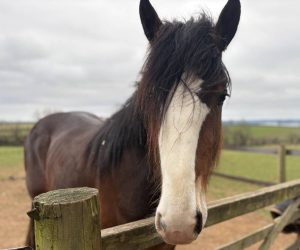
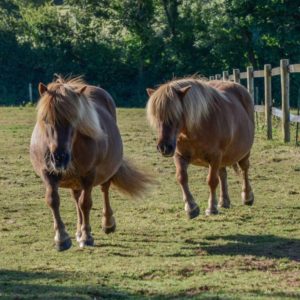
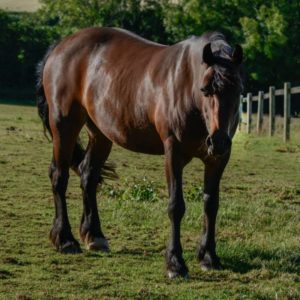
The Welsh pony and cob is known as a hardy and active breed that developed in the Welsh mountains and was originally used in coal mines, there is evidence that the Welsh Cob was in Wales before 1600 BC. A saddle type was developed by introducing Thoroughbred and Arabian blood making the breed to be all-purpose. They have been used extensively on farms, in the military, for hunting, and commercially in harness. Founded in 1901, the Welsh Pony & Cob Society is the largest of Britain’s Native Breed Societies, the first Welsh Pony and Cob Stud Book was established in 1902.
There are four types of Welsh Ponies and Cobs and come in the many beautiful equine colours including brown, grullo, palomino, chestnut, bay, gray, black, and dun, they cannot be skewbald or piebald. Weighing from 400-700 pounds and 12 (48 inches) to 15 hands (60 inches).
Breed Standard Sections A & B
Section A Welsh Mountain Pony will have a high level of intelligence, as well as a temperament that makes these ponies ideal for children. These ponies will also make good harness horses. They will feature elegant legs, good girth depth, and delicate heads.
Section B Welsh Pony has all of the same wonderful attributes that are associated with the Welsh Mountain Pony. However, these are even better riding ponies, even for children. They have an outstanding temperament, combined with a natural talent for jumping. They should have excellent action, thanks to their sloping shoulders.
- Height – not more than 12 hands high.
- Head – should be small, clean cut and tapering to the muzzle
- Hind quarters – lengthy and fine, tail carried gaily
- Hind legs – Hocks large, flat and not turning in or outward, legs not too bent
- Shoulders – long and sloping well back, withers moderately fine
- Hoofs – well-shaped and dense
- Eyes – bold
- Ears – well place, small and pointed high on the head and proportionately close
- Neck – lengthy and well carried, lean in mares and cresty in mature stallions
- Forelegs – set square and not tied at the elbows, long strong forearms
- Action – Quick free and straight from the shoulder. Knees and hocks well flexed with straight and powerful leverage.
Breed Standard Sections C & D
Section C Welsh Pony, cob type, is sure-footed, hardy, and active. This is an ideal horse for both children and adults, as well as those who want to compete at higher levels or just ride for pleasure. These animals are versatile, natural jumpers, and they do well in harness as well. Their body should compact and feature a deep girth, and the legs should be muscular and short.
Section D Welsh Cob can be described as a wonderful riding horse that is renowned for its tractability, endurance, and courage. These horses are agile, hardy, and strong, and they also feature a lovely temperament that is ideal for all levels of riders.
- Height – not more than 13.2 hands high (section C) above 13.3 hands high (section D).
- Head – will showcase the same delicate features that are found on all of the Welsh Pony types.
- Hind – quarters must be strong and lengthy
- Hind legs – Hocks large, flat and not turning in or outward.
- Shoulders – strong and well laid back
- Hoofs – well-shaped and dense
- Eyes – bold, prominent and set wide apart.
- Ears – neat and well set
- Neck – lengthy and well carried, lean in mares and cresty in mature stallions
- Forelegs – set square and not tied at the elbows, long strong forearms
- Feathering -silky (not course) at the heels.
- Action – Free true and forcible. The knee should be bent and the whole foreleg extended straight from the shoulder and as far forward as possible in trot.
Welsh ponies are a British Native Breed, they are only 1 of 2 British Native Equine breeds that are not on the Rare Breeds Survival Trusts watchlist: please use the following links
https://wpcs.uk.com/
https://www.rbst.org.uk/watchlist-overview