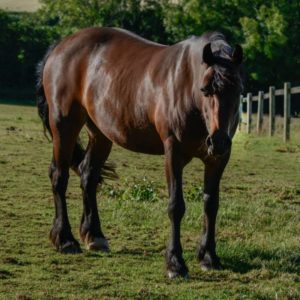
The ponies arrived in mainland Britain during the mid-19th century and have existed in the Shetland isles for over 2000 years. During the industrial revolution, the need for coal increased dramatically, and in 1847, a law was passed that banned women and children from being used to haul coal out of the pits. Miners turned to Shetland ponies, and thousands were imported to the mainland to be pit ponies. In the late 19th the century the Shetland pony grew in popularity with thousands of ponies left the islands and thus the Shetland Pony Stud-Book Society was formed in 1890 with the aim of publishing a Stud-Book which was the first for a native breed of pony in Britain.
Today, the Shetland no longer has the hardworking life of its ancestors and the ponies are used for pleasure driving, children’s ponies and therapy ponies. Queen Victoria owned several pairs of Shetlands for drawing their smart phaetons. Shetland pony racing known as the ‘Shetland grand national’ has become a popular sport. They also make great companions for other horses as they have a brave hardy nature and often don’t worry about being left alone. although wild herds still exist on the Shetland Islands.
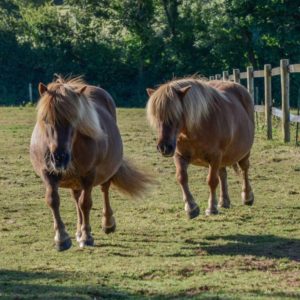
A most salient and essential feature of the Shetland pony is its general air of vitality (presence), stamina and robustness. The height limit for all adult Shetland ponies is 10.3hh (107 cm). ponies over 86cm are known as standard and under 86cm are known as miniatures. They can come in any colour apart from spotted. It is said that pound for pound a Shetland pony can pull more weight than some of the biggest horses. Besides the immense strength in their small bodies, Shetland ponies also are known for their long lifespans, with many living more than 30 years
Breed Standard
The UK Shetland Pony Stud-Book Society sets the breed standard for registered Shetland ponies world-wide.
- Height – Registered stock must not exceed 42 inches (107cm). Ponies are measured from the withers to the ground, by measuring stick, and a level stance, preferably concrete, should be used.
- Colour – any colour known in horses except spotted.
- Coat – A double coat in winter with guard hairs which shed the rain and keep the pony’s skin completely dry in the worst of the weather and, in summer a short coat which should carry a beautiful silky sheen. At all times the mane and tail hair should be long, straight and profuse.
- Head -The head should be small, and in proportion. Ears should be small and erect, wide set but pointing well forward. Forehead should be broad with bold, dark, intelligent eyes. Muzzle must be broad with nostrils wide and open. Teeth and jaw must be correct.
- Body – The neck should be properly set onto the shoulder, which in turn should be sloping, not upright, and end in a well-defined wither. The body should be strong, with plenty of heart room, well sprung ribs, the loin strong and muscular. The quarters should be broad and long with the tail set well up on them.
- Forelegs – These should have good, flat bone. Strong forearm. Short balanced cannon bone. Springy pasterns.
- Hindlegs – The thighs should be strong and muscular with well-shaped strong hocks. When viewed from behind, the hindlegs should not be set too widely apart, nor should the hocks be turned in.
Feet – Tough, round and well-shaped. - Action – Straight, free action using every joint. Tracking up well.
Shetland ponies are a British Native Breed, they are only 1 of 2 British Native Equine breeds that are not on the Rare Breeds Survival Trusts watchlist: please use the following links:
https://www.shetlandponystudbooksociety.co.uk
https://www.rbst.org.uk/watchlist-overview