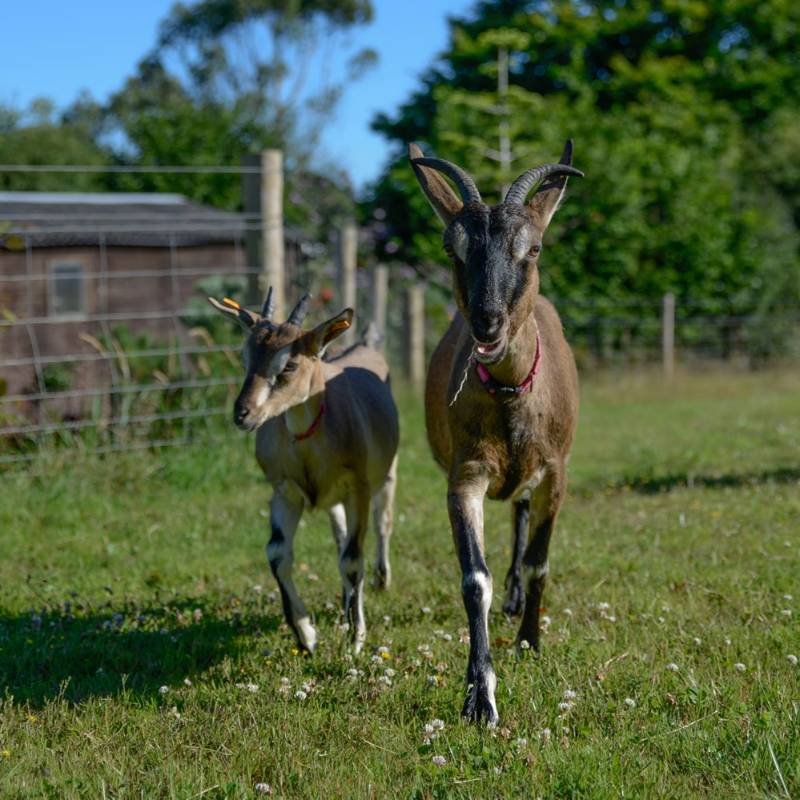
There are written references to the “English Goat” dating back to Georgian times but the first known picture of the English Goat was taken in 1872.Crossbreeding of the English Goat with other breeds from around the world became popular during the early part of the 20th Century, and so the English Goat Movement was formed to preserve the breed. By 1938 the English Goat had fallen from favour and the movement disbanded on the death of their owner in 1952/69. A second English Goat Breeders Association was set up in 1978 with an agreed breed standard and in 1993 this became the official Herd Book and all pedigree English Goats are recorded in here.
English Goats are inquisitive, docile and co-operative. They produce enough milk to fulfil normal household needs on a minimum volume of concentrated feed. Capable of milking through two years, they give a good conversion rate of milk and meat. They consume a wide range of fodder and thrive in the British climate. A male goat can weigh up to 140 kg and female goat up to 110 kg. Male goats are called Bucks or Billy’s and usually have a beard. Females are called Does or Nannies, with immature goats being called kids.
The naturally high level of solids in their milk means this it makes lovely cheeses, and some make it into soap. The conversion rate into meat means that young stock can be expected to be butcher-ready at 12 months and their meat has a superb flavour. Their skins are used for making drums and also make beautiful rugs, and the winter undercoat of the English Goat is “Cashmere” which is incredibly soft and warm.
Breed Standard
- An English goat must be first and foremost a sound animal with no features which appear likely to interfere with its health and productivity.
- Udder should be well attached and level, elastic, silky, not fleshy.
- Teats well-spaced, of even size and pointed slightly forward.
- Legs strong and straight, hocks not turned in.
- Teeth normal: not overshot nor undershot jaw.
- The body sturdy and deep, with well-sprung ribs and strong loins. Rectangular shape when viewed from the side or above. Back level with gentle slope towards the tail.
- Neat head tapering to a moderately fine muzzle. Frontal bone prominent. Facial profile straight or concave, not convex. Moderate beard in females, heavy in males.
- If not disbudded or naturally polled, horns rise slightly at first with an inclination to the rear and then curve outward.
- Ears neither erect nor pendulous but approaching the horizontal position pointing forward.
- The outer coat of females fairly short and dense. Sometimes there is a longer fringe along the back, on the flanks, and thicker tufts on the legs. Males outer coat much longer, particularly on the back, neck, chest and thighs.
- On parting the hair an inner coat of fine soft wool is seen. This is often sparse or absent in Spring and Summer.
- Colours are variable, usually shades of brown or grey with characteristic markings, i.e., eel stripe (dark line along back) and associated leg, neck and flank markings. These must be present at least to the extent of a definite eel stripe, even if this is incomplete. White patches are permitted. Swiss type face markings should preferably be absent or indistinct, but do not disqualify.
- Naturally absent tassels. Goats with tassels are not acceptable for registration, even if this is the only fault.
English Goats are currently on the Rare Breed Survival Trusts Priority list: for more information, please use the following links:
https://www.rbst.org.uk/english-goat
https://www.egba.org.uk